· FieldDojo Team · electrical · 11 min read
Breaker Sizing: NEC 240.6 Standard Ratings and the Next-Size-Up Rule
How to size a circuit breaker the way the NEC does it — 125% on continuous load, round up to a 240.6(A) standard rating, then prove the conductor can live with it under 240.4.
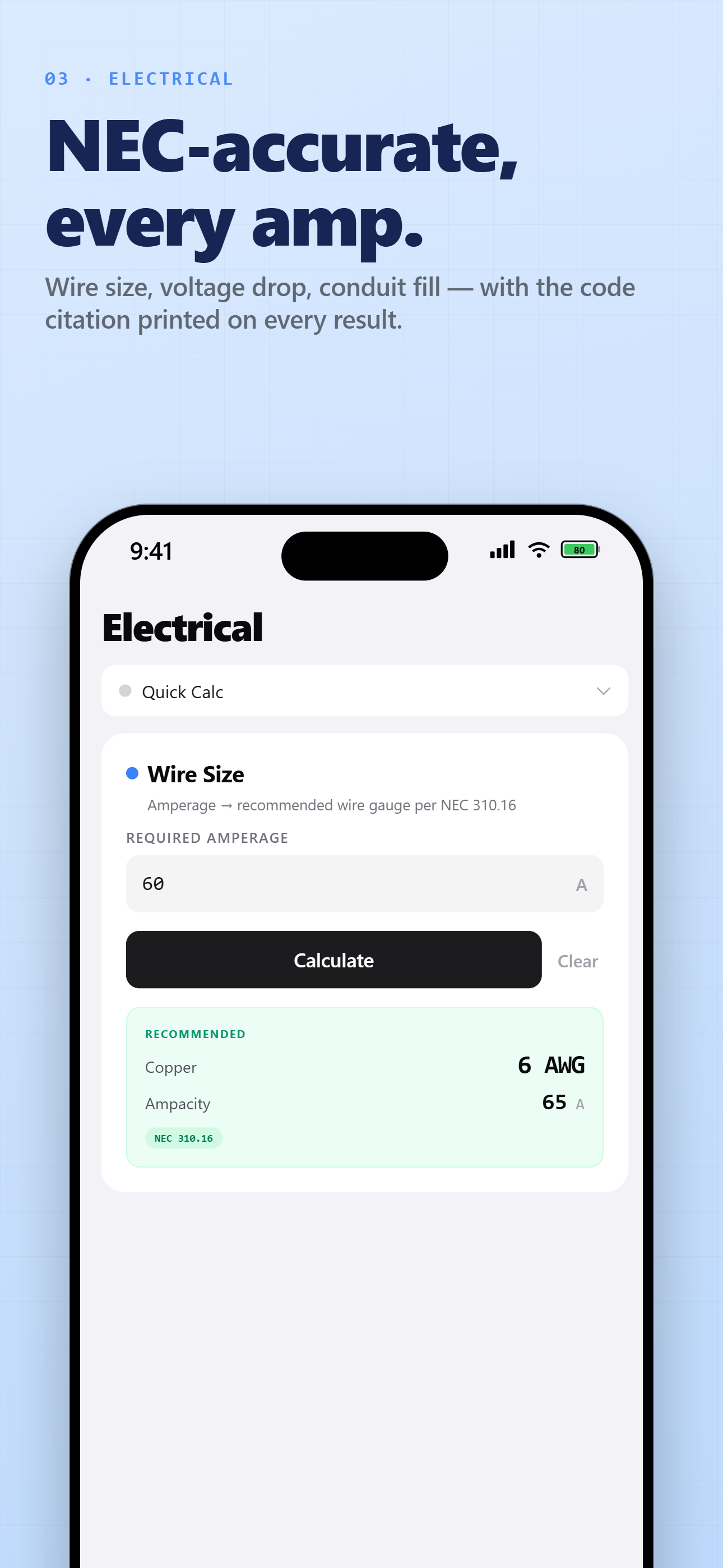
“What size breaker do I need?” has two answers, and an inspector checks both. The first comes from the load: NEC 210.20(A) says the overcurrent device must be rated for 125% of the continuous load plus 100% of everything else, rounded up to a standard rating from Table 240.6(A). The second comes from the wire: NEC 240.4 says the breaker cannot exceed the conductor’s ampacity, with hard caps on small conductors and one narrow allowance to go a size up. Size from the load, then check against the wire, and let the stricter answer win. This guide walks through both, with the standard-ratings list, three worked examples, the next-size-up rule, and the questions electricians actually search for.
Verify before you build. Section numbers, table values, and demand factors change between code editions, and jurisdictions adopt them with local amendments. Treat this guide — and the app — as a calculation aid, not as the code book: confirm every number against the edition your authority having jurisdiction enforces. How FieldDojo validates its calculations.
Written against the 2023 edition of NFPA 70, the National Electrical Code. Section numbers below are 2023; the 2017 and 2020 numbering for these rules is the same.
The Standard Breaker Ratings — NEC 240.6(A)
You cannot install a breaker rated at your arithmetic. The code fixes the list of standard ampere ratings, and the device you buy is one of them:
| Range | Standard ratings (A) |
|---|---|
| Under 100 A | 15, 20, 25, 30, 35, 40, 45, 50, 60, 70, 80, 90 |
| 100 – 600 A | 100, 110, 125, 150, 175, 200, 225, 250, 300, 350, 400, 450, 500, 600 |
| Over 600 A | 700, 800, 1000, 1200, 1600, 2000, 2500, 3000, 4000, 5000, 6000 |
Source: NEC 240.6(A). The same section lists 1, 3, 6, 10 and 601 A as additional standard ratings for fuses only.
Two things about the list catch people. The gaps are irregular — there is a 45 but no 55, a 110 but no 130 — and the list ends at 6000 A. A computed minimum above 6000 A has no standard rating and the circuit has to be engineered, not looked up. Nonstandard ratings are permitted by 240.6(A) if the device is listed for them, but “permitted” is not “stocked”: design on the standard list unless a spec sheet says otherwise.
Step 1: Sort the Load Into Continuous and Non-Continuous
NEC Article 100 defines a continuous load as one where the maximum current is expected to run for three hours or more. The test is the clock, not the equipment type:
- Continuous: EV chargers, storefront and parking-lot lighting, sign circuits, heat tape, most commercial HVAC blowers. NEC 422.13 also tells you to treat a fixed storage water heater of 120 gallons or less as continuous regardless of how long it actually runs.
- Non-continuous: general-purpose receptacles, a residential range, a dryer, a garage door opener — anything that cycles well inside three hours.
A load that runs 2 hours 45 minutes is non-continuous. Move it to three hours and the same amps need a bigger breaker.
Step 2: Compute the Minimum — NEC 210.20(A)
For a branch circuit (215.3 says the same for feeders):
Minimum OCPD rating = (continuous load × 1.25) + non-continuous loadThe 125% factor exists because a standard breaker is not listed to sit at 100% of its rating for hours on end — held there, the device and its terminations heat up and it can trip below its rating. Multiplying the continuous load by 1.25 keeps a continuously loaded breaker at or below 80% of its rating, which is the territory it was tested for. The exception in 210.20(A) for assemblies listed for 100% continuous operation is real but rare — you buy it on purpose, and the listing says so.
The conductor gets the same treatment. NEC 210.19(A)(1) requires the branch-circuit conductor to have an ampacity of at least 125% of the continuous load plus the non-continuous load, before any adjustment or correction. So the 125% factor is not a breaker rule — it is a circuit rule that both the breaker and the wire have to satisfy.
Step 3: Round Up to a Standard Rating
Take the minimum from Step 2 and pick the first 240.6(A) rating that is equal to or greater than it. Never round down — a 42 A minimum becomes a 45 A breaker, not a 40 A one. The headroom between your minimum and the rating belongs to the arithmetic, not to the next appliance someone plugs in.
Run these three steps in the browser with the breaker size calculator, which shows the computed minimum and the selected rating side by side.
Step 4: Check the Breaker Against the Conductor — NEC 240.4
This is the step that fails inspections, because the breaker arithmetic looks finished. The breaker’s other job is to protect the conductor, and 240.4 runs the check in the opposite direction: the conductor’s ampacity — from Table 310.16, after any derating under 310.15 — must support the breaker you picked.
The Small-Conductor Caps — NEC 240.4(D)
For the sizes on every residential job, the code fixes the maximum breaker regardless of what the ampacity column says:
| Conductor | Max breaker per 240.4(D) | Table 310.16 ampacity (75°C) |
|---|---|---|
| 14 AWG copper | 15 A | 20 A |
| 12 AWG copper | 20 A | 25 A |
| 10 AWG copper | 30 A | 35 A |
| 12 AWG aluminum | 15 A | 20 A |
| 10 AWG aluminum | 25 A | 30 A |
10 AWG copper really is rated 35 A at 75°C, but the breaker protecting it stops at 30 A. From 8 AWG up, no cap applies and the ampacity governs directly — the wire sizing guide has the full 75°C column and the derating factors.
The Next-Size-Up Allowance — NEC 240.4(B)
When the conductor’s ampacity does not land on a standard rating, 240.4(B) lets the breaker be the next standard rating above the ampacity, provided all three conditions hold:
- The conductors are not part of a branch circuit supplying more than one receptacle for cord-and-plug-connected portable loads.
- The ampacity does not correspond to a standard rating in 240.6(A).
- The next standard rating does not exceed 800 A.
A 6 AWG copper conductor at 65 A, derated to 80% for four to six current-carrying conductors in a raceway, has an adjusted ampacity of 52 A. There is no 52 A breaker; 240.4(B) permits 60 A. That does not increase the load the wire can carry — 210.19 still limits the calculated load to the 52 A ampacity — it only settles which device protects it. Above 800 A, 240.4(C) flips the rule: the conductor ampacity has to be at least the breaker rating.
Worked Example 1: Mixed Continuous and Non-Continuous Load
A circuit carrying 24 A of continuous load and 8 A of non-continuous load.
(24 A × 1.25) + 8 A = 38 A minimumThere is no 38 A breaker. The next standard rating is 40 A. On the conductor side, 210.19(A)(1) needs an ampacity of at least 38 A before derating: 8 AWG copper (50 A at 75°C) is the first size that clears both the 38 A and the 40 A breaker; 10 AWG stops at 30 A under 240.4(D) no matter what its column says.
Worked Example 2: A 48 A EV Charger
A hardwired Level 2 charger with a 48 A maximum output is continuous by definition.
48 A × 1.25 = 60 A minimum60 is a standard rating, so a 60 A breaker with zero headroom — which is exactly why 60 A is the breaker every 48 A charger’s instructions call for. The conductor also needs 60 A: 6 AWG copper (65 A at 75°C) is the standard answer, and 240.4(B) is not needed because 65 A already exceeds 60 A. Whether the panel can absorb the added 11,520 VA is a different calculation — the NEC 220 load calculation guide runs that same charger through a 125 A service both with and without an energy management system.
Worked Example 3: A 4,500 W Water Heater
A 4,500 W element at 240 V draws 18.75 A. Under 422.13 it is continuous:
18.75 A × 1.25 = 23.4 A minimumThere is no 23 A breaker. The next standard rating is 25 A. That rules out 12 AWG — 240.4(D) caps it at a 20 A breaker — so the circuit is 10 AWG copper on a 25 A device. Nobody stocks a 23 A breaker; the list decides.
Motors Are a Different Rule
Do not run a motor branch circuit through the 125% rule. NEC 430.52 sizes the short-circuit and ground-fault device from multipliers on the motor’s table full-load current (up to 250% for an inverse-time breaker), and the result can legitimately land far above the conductor ampacity — the overload relay, not the breaker, protects the motor. Feed a motor through 210.20(A) and you get a breaker that trips on starting inrush. Start from Table 430.248 or 430.250 with the motor FLA calculator instead.
Common Breaker Sizing Mistakes
1. Sizing the breaker and calling the circuit done. The 240.4 check runs the other way — the wire, after derating, has to support the breaker. Size the wire separately and let the stricter answer win.
2. Misfiling continuous loads. Storefront lighting, heat tape, and parking-lot circuits get called non-continuous constantly. The undersized breaker then nuisance-trips in exactly the season the circuit works hardest.
3. Rounding down at a gap in the list. A 42 A minimum goes up to 45, never down to 40.
4. Treating the rounded-up rating as spare capacity. The 2 A between a 38 A minimum and a 40 A breaker is not room for another load; 210.19 still limits the load to what the conductor is rated for.
5. Using 240.4(B) to justify a bigger load. Next-size-up settles which device protects the conductor; it never raises the conductor’s ampacity.
6. Applying the 125% rule to motors. See above — 430.52 governs, and the answer is usually larger than instinct says.
Frequently Asked Questions
What size breaker do I need for a 40 amp load?
It depends on whether the load is continuous. Forty amps of non-continuous load needs a device rated at least 40 A, and 40 is a standard 240.6(A) rating, so a 40 A breaker works. Forty amps of continuous load — running three hours or more — is taken at 125%, which is 50 A, so you need a 50 A breaker and a conductor rated for it.
Is 45 amps a standard breaker size?
Yes. 45 A is on the NEC 240.6(A) list, between 40 and 50, even though supply houses rarely stock it. What you cannot do is invent a rating that is not on the list: if your computed minimum is 42 A, the answer is 45 A, not 40 A.
Can a breaker be larger than the wire’s ampacity?
Only under NEC 240.4(B), and only by one standard size: when the conductor’s ampacity does not match a standard rating, the next rating up is permitted as long as the circuit does not supply multiple cord-and-plug receptacles and the device is 800 A or less. The small-conductor caps in 240.4(D) still apply — 14, 12 and 10 AWG copper stop at 15, 20 and 30 A regardless.
What size breaker for 10 AWG wire?
30 A maximum for 10 AWG copper, or 25 A for 10 AWG aluminum, under NEC 240.4(D). The 75°C column of Table 310.16 gives 10 AWG copper 35 A, but the breaker cap is the binding constraint — the extra ampacity only helps with derating.
What size breaker does a 48 amp EV charger need?
60 A. A 48 A charger is a continuous load, so NEC 210.20(A) requires 48 × 1.25 = 60 A, and 60 is a standard rating. The conductor also has to be good for 60 A after any derating — 6 AWG copper at 75°C is the usual answer.
How do I know if a load is continuous?
NEC Article 100 defines it: the maximum current is expected to continue for three hours or more. EV chargers, commercial lighting, sign circuits and heat tape qualify; NEC 422.13 also makes a storage water heater of 120 gallons or less continuous by rule. A residential range, dryer or receptacle circuit is non-continuous.
How FieldDojo Handles This
The Breaker Size calculator in FieldDojo takes the continuous and non-continuous amps, applies the 125% factor from NEC 210.20(A), and returns the computed minimum next to the first standard 240.6(A) rating that covers it — with the arithmetic and the code section printed on the result. It refuses rather than guesses above 6000 A, and it will not size a motor circuit. The same tool runs in the browser at /calculators/breaker-size.
For the conductor side of the check, the Wire Size calculator applies Table 310.16 and the 240.4(D) caps, and the web ampacity derating calculator applies the 310.15 adjustment factors before you compare against the breaker.
Get FieldDojo on the App Store → or on Google Play → — free on both.
All 57 calculators are free, work offline, and cite the code section on every result. FieldDojo Pro adds unlimited history, PDF reports, project folders and cloud sync.