· Updated · FieldDojo Team · electrical · 9 min read
Residential Electrical Load Calculation: NEC Article 220 Guide
How to calculate residential service load with the NEC Article 220 standard and optional methods — required for service sizing and permit applications.
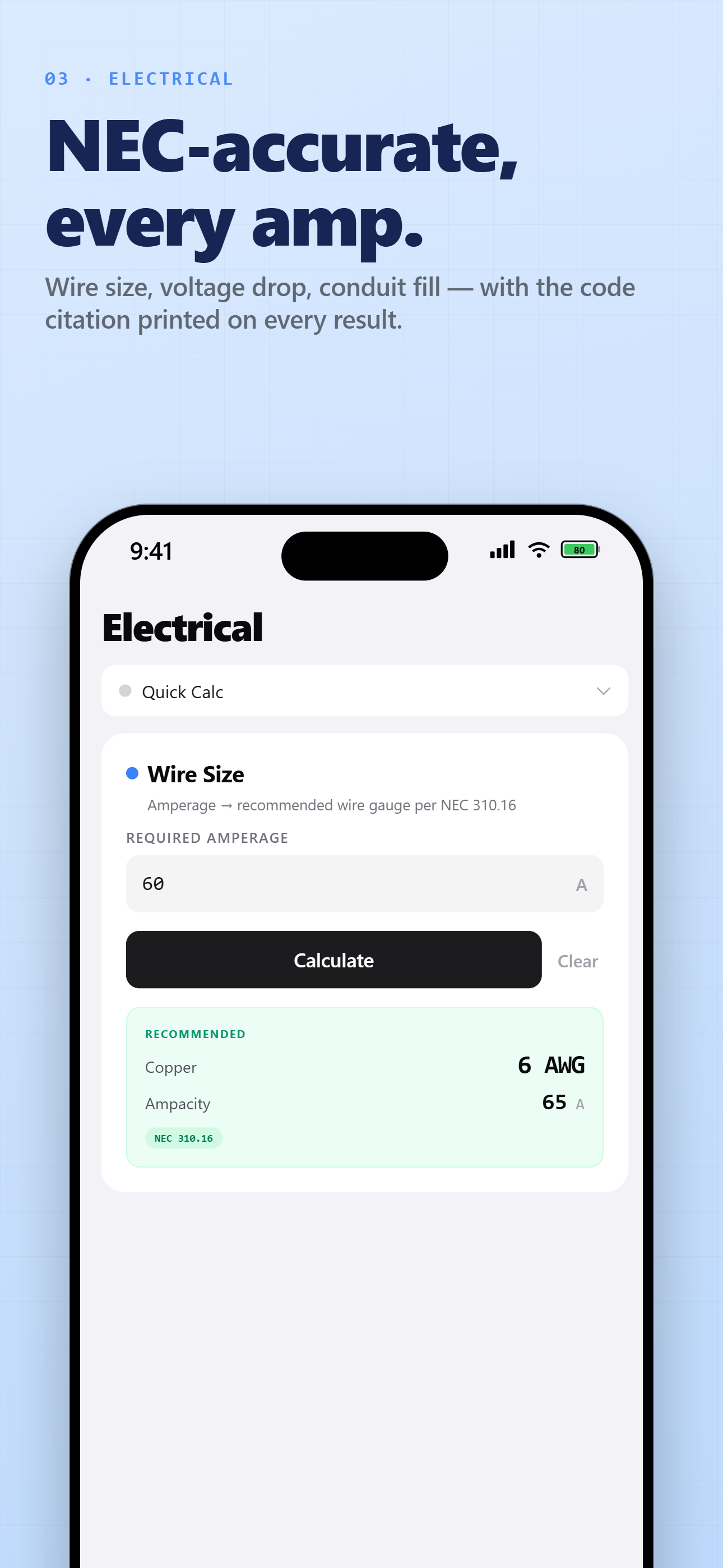
Sizing a residential electrical service starts with a load calculation. Undersized service trips breakers and fails inspection. Oversized service wastes money on excess panel capacity. NEC Article 220 provides two methods — here’s how to use each one.
Verify before you build. Section numbers, table values, and demand factors change between code editions, and jurisdictions adopt them with local amendments. Treat this guide — and the app — as a calculation aid, not as the code book: confirm every number against the edition your authority having jurisdiction enforces. How FieldDojo validates its calculations.
The Two Methods
Standard Method (NEC 220.40–220.60): calculates each load individually and applies demand factors from the NEC tables. Required for multi-family dwellings and unusual loads.
Optional Method (NEC 220.82): a simplified calculation for single-family dwellings served by a 100 A or larger service. Widely accepted for permits — most residential electricians use this.
Optional Method — NEC 220.82
The demand factor is simple: the first 10 kVA of general load counts at 100%, everything above that at 40%. Heating or air-conditioning is added afterward.
Total load = first 10 kVA + (remaining kVA × 40%) + largest HVAC load
So what goes into “general load”?
Step 1: Tabulate All Loads
General lighting and receptacle load: 3 VA per sq ft (NEC 220.12) for the floor area of the dwelling.
For a 2,000 sq ft house: 2,000 × 3 = 6,000 VA
Small appliance circuits: 1,500 VA each × 2 required circuits minimum = 3,000 VA
Laundry circuit: 1,500 VA (NEC 220.52)
Fixed appliances: Nameplate VA (or watts) for:
- Electric range: nameplate or 8,000 VA minimum
- Dryer: nameplate or 5,000 VA minimum
- Dishwasher: nameplate (typical 1,200–1,800 VA)
- Microwave: nameplate
- Water heater: nameplate
- Disposal: nameplate
- Any other fixed motor load
Heating or cooling (largest of the two): Take the larger of:
- Air conditioning compressor + air handler
- Electric heating strips (total) This is always 100% — no demand factor.
Step 2: Apply the Demand Factor
Add up all general loads (everything except HVAC):
Example house — 2,000 sq ft:
- General lighting: 6,000 VA
- Small appliance circuits: 3,000 VA
- Laundry: 1,500 VA
- Electric range: 8,000 VA
- Dryer: 5,000 VA
- Dishwasher: 1,200 VA
- Water heater: 4,500 VA
- Subtotal: 29,200 VA
Apply Optional Method demand factor:
- First 10,000 VA × 100% = 10,000 VA
- Remaining 19,200 VA × 40% = 7,680 VA
- Subtotal after demand = 17,680 VA
Add HVAC (100%):
- 5-ton AC compressor + air handler = 8,400 VA
- Total = 26,080 VA
Step 3: Calculate Service Current
Single-phase 240V service:
I = Total VA ÷ Voltage
I = 26,080 ÷ 240 = 108.7 A
Round up to standard service size: 125A minimum — but most residential new construction uses 200A for future capacity.
Standard Method Overview (NEC 220.40–220.60)
The standard method calculates loads room-by-room and applies specific demand factors from NEC tables:
Lighting demand factors (NEC Table 220.42):
| Portion of Load (VA) | Demand Factor |
|---|---|
| First 3,000 VA | 100% |
| 3,001 to 120,000 VA | 35% |
| Over 120,000 VA | 25% |
Appliance demand factors (NEC 220.53): For 4 or more fixed appliances (excluding ranges, dryers, AC), apply 75% demand factor to the combined load.
Range demand (NEC Table 220.55): Ranges 12 kW or less: 8,000 VA demand. For ranges over 12 kW, add 5% per kW over 12 kW.
Dryer demand (NEC 220.54): 5,000 VA or nameplate, whichever is larger. For 4 or more dryers, use Table 220.54.
The standard method is more precise for unusual loads and is required when the optional method isn’t applicable (multi-family, for example).
Which Method Should You Use?
Both methods are code-compliant where they apply. The choice comes down to what the dwelling is and what loads it carries:
| Situation | Method | Why |
|---|---|---|
| Single-family dwelling, 100 A or larger service | Optional (220.82) | Simplest math, widely accepted for permits |
| Service smaller than 100 A | Standard (220.40–220.60) | The optional method only applies at 100 A and up |
| Multi-family dwelling | Standard | Required — the optional method doesn’t cover it |
| Unusual or heavy fixed loads | Standard | The demand tables handle them more precisely |
| Adding one large load (EVSE, hot tub) to a single-family home | Optional | Re-run 220.82 with the new load — see the EV example below |
When both methods apply, run the optional method first. It’s faster, and for a typical single-family house it’s the calculation the permit office sees most often.
What Size Are the Service Entrance Conductors?
Once you have the demand load in amperes, size service entrance conductors per NEC 310.15:
| Service Amperage | Copper (THW/THWN-2) | Aluminum (USE-2) |
|---|---|---|
| 100A | 4 AWG | 2 AWG |
| 125A | 2 AWG | 1/0 AWG |
| 150A | 1 AWG | 2/0 AWG |
| 200A | 2/0 AWG | 4/0 AWG |
Note: these dwelling-service sizes are smaller than a straight Table 310.16 lookup because NEC 310.12 permits reduced conductor sizes for single-phase dwelling services.
These dwelling-service sizes are smaller than a straight NEC Table 310.16 lookup would give — 2/0 copper is listed at 175 A in the 75°C column, yet it’s the standard conductor for a 200 A residential service. NEC 310.12 permits reduced conductor sizing for single-phase dwelling services and feeders because a whole-house load is diverse — it never runs everything at once, the same reason Article 220 applies demand factors in the first place. Don’t carry these sizes over to branch circuits or feeders that don’t qualify; those come straight from Table 310.16.
Which Additions Force a Service Upgrade?
EV charger: Level 2 EVSE at 48A continuous requires 60A circuit (48A × 125% = 60A). On a 200A service with modern load profile, typically manageable. On 100A service, may require upgrade.
Hot tub/spa: Typical 50A–60A dedicated circuit at 240V.
Addition with electric heat: Electric resistance heating adds significant load. A 10 kW baseboard heater adds 10,000 VA at 100% to the calculation.
EV Load Management
NEC 220.57 (added in the 2023 NEC) requires EVSE load to be taken at 7,200 VA or the nameplate rating, whichever is larger. If an energy management system (EMS) limits the charger’s draw per NEC 625.42, the load calculation can use the EMS-limited maximum instead of the full nameplate — which is how many homes add a Level 2 charger without a service upgrade.
Worked Example: Adding a 48 A EV Charger to the Same House
Take the 2,000 sq ft house from above — 29,200 VA of general load, 8,400 VA of AC, calculated at 108.7 A on a 125 A service. The owner wants a 48 A Level 2 charger. Run the numbers both ways.
Path 1 — No Energy Management System
NEC 220.57 counts the EVSE at 7,200 VA or nameplate, whichever is larger. Nameplate here is 48 A × 240 V = 11,520 VA — larger than 7,200 VA, so 11,520 VA joins the general load and rides through the same demand factor:
- General load: 29,200 + 11,520 = 40,720 VA
- First 10,000 VA × 100% = 10,000 VA
- Remaining 30,720 VA × 40% = 12,288 VA
- Subtotal after demand = 22,288 VA
- Add AC at 100%: 22,288 + 8,400 = 30,688 VA
I = 30,688 ÷ 240 = 127.9 A127.9 A is over 125 A, so the existing service no longer qualifies — the next standard size is 150 A. On a 200 A service the charger fits with room to spare; on this 125 A service it triggers a service upgrade. The branch circuit is the same either way: 48 A continuous × 125% = 60 A breaker — the breaker sizing guide walks that rule, or run it in the breaker size calculator.
Path 2 — EMS-Limited per NEC 625.42
Instead, set an energy management system to hold the charger at 30 A (7,200 VA). NEC 220.57 lets the calculation use the EMS-limited maximum rather than the full nameplate:
- General load: 29,200 + 7,200 = 36,400 VA
- First 10,000 VA × 100% = 10,000 VA
- Remaining 26,400 VA × 40% = 10,560 VA
- Subtotal after demand = 20,560 VA
- Add AC at 100%: 20,560 + 8,400 = 28,960 VA
I = 28,960 ÷ 240 = 120.7 A120.7 A stays under 125 A. Same house, same charger hardware, no service upgrade — the EMS setting is the difference between a permit that sails through and a service-entrance job. The trade-off is charging speed: the charger tops out at 30 A instead of 48 A.
Frequently Asked Questions
How many amps does a 2,000 sq ft house need?
Run the NEC 220.82 optional method: a 2,000 sq ft house with an electric range, dryer, water heater, and 5-ton AC works out to roughly 26,000 VA — about 109 A at 240 V. That rounds up to a 125 A service minimum, though most new construction installs 200 A for future loads.
Can I add an EV charger to a 100 amp panel?
Often not at full nameplate — a 48 A Level 2 charger counts as 11,520 VA under NEC 220.57, which pushes most load calculations past 100 A. An energy management system per NEC 625.42 that caps the charger’s draw lets you use the lower EMS limit in the calculation, which is frequently the difference between passing and a service upgrade.
What is the demand factor in the NEC 220.82 optional method?
The first 10 kVA of general load counts at 100%, and everything above it counts at 40%. Heating or air-conditioning — whichever is larger — is added afterward at 100% with no demand factor. That single reduction replaces the separate lighting, appliance, range, and dryer demand tables the standard method uses.
Do you count heating or cooling in a load calculation?
The larger of the two, never both. A house doesn’t run electric heat strips and the AC compressor at the same time, so NEC 220.82 takes whichever load is bigger and adds it at 100%. Compare the AC compressor plus air handler against the total electric heat, then keep the winner.
What size wire do you need for a 200 amp service?
2/0 AWG copper or 4/0 AWG aluminum for a 200 A residential service entrance. These dwelling-service sizes are smaller than a straight Table 310.16 lookup — NEC 310.12 permits that for single-phase dwelling services and their feeders.
How many VA is an electric range in a load calculation?
Use the nameplate rating or 8,000 VA, whichever is larger, in the optional method. Under the standard method, NEC Table 220.55 assigns ranges of 12 kW or less a demand of 8,000 VA; for ranges over 12 kW, add 5% per kW above 12 kW.
How FieldDojo Handles This
You don’t need to carry the demand factors in your head on a service call. FieldDojo’s Dwelling Load calculator runs the Standard Method of Article 220 (try it in the browser at /calculators/nec-load-calculation):
- Enter floor area, fixed appliances, and the heating and A/C loads in VA
- Get the demand load in VA and amps, plus the minimum service size
- Every result cites the NEC 220 section it came from — 220.12, 220.52, 220.42, 220.55, 220.54, 220.53
The Optional Method of 220.82 is not in the app today; work that one by hand from the walkthrough above.
Get FieldDojo on the App Store → or on Google Play → — free on both.
Related trade guides: