· FieldDojo Team · electrical · 11 min read
Ground Wire Sizing: NEC Table 250.122 for Equipment Grounds and 250.66 for Electrode Conductors
Two different ground wires, two different tables. How to size an equipment grounding conductor from the breaker and a grounding electrode conductor from the service — with the full tables, the 250.122(B) upsize rule, and the ground-rod allowance.
“What size ground wire?” is two questions wearing one name. The equipment grounding conductor (EGC) is the fault-clearing path back to the source; it is sized from the breaker rating using NEC Table 250.122. The grounding electrode conductor (GEC) connects the system to earth; it is sized from the service-entrance conductors using NEC Table 250.66. Different conductors, different tables, different jobs — and mixing them up is the root of most grounding questions on a jobsite. This guide gives both tables in full, the proportional-upsize rule that fails inspections on long runs, the ground-rod allowance that saves copper, and worked examples for a 100 A subpanel and a 200 A service.
Verify before you build. Section numbers, table values, and demand factors change between code editions, and jurisdictions adopt them with local amendments. Treat this guide — and the app — as a calculation aid, not as the code book: confirm every number against the edition your authority having jurisdiction enforces. How FieldDojo validates its calculations.
Written against the 2023 edition of NFPA 70, the National Electrical Code. The 250.122(B) wording changed in the 2020 edition; that difference is called out below.
EGC or GEC? Decide That First
Ask which job the wire is doing, and the table picks itself.
| Conductor | Job | Sized from | Table |
|---|---|---|---|
| Equipment grounding conductor | Carries fault current back to the source so the breaker opens | The overcurrent device protecting the circuit | 250.122 |
| Grounding electrode conductor | Connects the electrical system to earth (rod, pipe, Ufer, ring) | The largest ungrounded service-entrance conductor | 250.66 |
The EGC scales with the breaker because a bigger breaker needs a bigger low-impedance path to trip it fast enough. The GEC scales with the service because earth is not a fault-clearing path in the same sense — it connects the system to ground for lightning, surge and voltage stabilisation, and its size tracks the system, not any one circuit. Bonding jumpers on the supply side follow 250.102 and are outside this guide.
One more distinction before the tables: a wire-type EGC is not always required. NEC 250.118 lists EMT, IMC, rigid metal conduit and several other raceways and cable armors as acceptable equipment grounding conductors in their own right. The tables below are for the wire you pull when the raceway is PVC, flexible, or when the spec calls for a wire-type EGC anyway.
Equipment Grounding Conductor — NEC Table 250.122
Enter the table with the rating of the breaker or fuse ahead of the circuit — not the load, not the conductor ampacity. Pick the row whose rating is equal to or greater than the device.
| Overcurrent device rating, not exceeding (A) | Copper | Aluminum |
|---|---|---|
| 15 | 14 AWG | 12 AWG |
| 20 | 12 AWG | 10 AWG |
| 60 | 10 AWG | 8 AWG |
| 100 | 8 AWG | 6 AWG |
| 200 | 6 AWG | 4 AWG |
| 300 | 4 AWG | 2 AWG |
| 400 | 3 AWG | 1 AWG |
| 500 | 2 AWG | 1/0 AWG |
| 600 | 1 AWG | 2/0 AWG |
| 800 | 1/0 AWG | 3/0 AWG |
| 1000 | 2/0 AWG | 4/0 AWG |
| 1200 | 3/0 AWG | 250 kcmil |
| 1600 | 4/0 AWG | 350 kcmil |
| 2000 | 250 kcmil | 400 kcmil |
| 2500 | 350 kcmil | 600 kcmil |
| 3000 | 400 kcmil | 600 kcmil |
| 4000 | 500 kcmil | 750 kcmil |
| 5000 | 700 kcmil | 1250 kcmil |
| 6000 | 800 kcmil | 1250 kcmil |
Source: NEC Table 250.122. Pre-2020 editions carried separate 30 A and 40 A rows; both called for 10 AWG copper, the same as the 60 A row, so the answer is unchanged.
The table is a floor. 250.122(A) adds that the EGC never has to be larger than the circuit’s ungrounded conductors — a 20 A circuit in 12 AWG does not need a 12 AWG ground upsized past the phase wires — and 250.4(A)(5) still requires the whole fault path to be effective, which is a design question the table does not answer for you. Look up any rating in the browser with the ground wire size calculator.
The Proportional Upsize — NEC 250.122(B)
This is the rule that fails inspections, because it is invisible from the breaker. If the ungrounded conductors are increased in size for any reason other than ampacity adjustment or correction under 310.15(B) or 310.15(C) — voltage drop is the usual reason — a wire-type EGC has to be increased in proportion to the increase in circular-mil area. That “other than” language arrived in the 2020 edition; before it, any upsize triggered the rule, so check which edition your jurisdiction enforces.
The arithmetic:
EGC_min (CM) = Table 250.122 EGC (CM) × (new phase conductor CM ÷ minimum phase conductor CM)Then pick the first standard size at or above that area. Circular-mil areas for the common sizes are in the wire sizing guide.
Parallel Runs — NEC 250.122(F)
Where conductors run in parallel in more than one raceway or cable, each raceway gets its own EGC, and each is sized from Table 250.122 using the full rating of the overcurrent device — not a share of it. Four parallel sets on a 1200 A breaker means four 3/0 copper EGCs, one per raceway.
Grounding Electrode Conductor — NEC Table 250.66
Enter this table with the largest ungrounded service-entrance conductor (or the equivalent area of parallel sets), not the service rating.
| Largest service conductor — copper | Largest service conductor — aluminum | GEC copper | GEC aluminum |
|---|---|---|---|
| 2 AWG or smaller | 1/0 AWG or smaller | 8 AWG | 6 AWG |
| 1 or 1/0 AWG | 2/0 or 3/0 AWG | 6 AWG | 4 AWG |
| 2/0 or 3/0 AWG | 4/0 AWG or 250 kcmil | 4 AWG | 2 AWG |
| Over 3/0 AWG through 350 kcmil | Over 250 through 500 kcmil | 2 AWG | 1/0 AWG |
| Over 350 through 600 kcmil | Over 500 through 900 kcmil | 1/0 AWG | 3/0 AWG |
| Over 600 through 1100 kcmil | Over 900 through 1750 kcmil | 2/0 AWG | 4/0 AWG |
| Over 1100 kcmil | Over 1750 kcmil | 3/0 AWG | 250 kcmil |
Source: NEC Table 250.66.
The Electrode Allowances — NEC 250.66(A), (B), (C)
The table answer is often larger than what you actually have to run, because three subsections cap the conductor by the electrode it lands on:
- Rod, pipe or plate electrodes — 250.66(A): the portion of the GEC that is the sole connection to the electrode never has to exceed 6 AWG copper or 4 AWG aluminum.
- Concrete-encased electrode (Ufer) — 250.66(B): never has to exceed 4 AWG copper.
- Ground ring — 250.66(C): never has to be larger than the ring conductor itself.
The allowance applies to that electrode’s connection, not to the whole grounding electrode system. A GEC that also serves a metal water pipe electrode, for instance, is sized from the table for that portion. And aluminum is not welcome everywhere: 250.64(A) keeps aluminum grounding conductors away from earth contact and masonry, and terminations outdoors have to stay at least 18 inches above finished grade.
Worked Example 1: A 100 A Feeder to a Subpanel
A 100 A breaker feeds a detached-garage subpanel, run in copper in PVC conduit — so a wire-type EGC is required.
Table 250.122, 100 A row: 8 AWG copper (6 AWG if the EGC is aluminum).
Now the trap. The run is 180 feet, and to hold voltage drop the ungrounded conductors were upsized from 3 AWG (the 100 A minimum at 75°C) to 1 AWG. That is an upsize for a reason other than derating, so 250.122(B) applies:
Ratio = 83,690 CM (1 AWG) ÷ 52,620 CM (3 AWG) = 1.59
EGC_min = 16,510 CM (8 AWG) × 1.59 = 26,260 CM
6 AWG copper is 26,240 CM — 20 circular mils short. The first size that clears 26,260 CM is 4 AWG copper. Leaving the ground at 8 AWG because the breaker is still 100 A is a failed inspection; landing on 6 AWG by eye is a failed inspection by 20 circular mils. Run the ratio, not the instinct.
Worked Example 2: A 200 A Residential Service
A 200 A service with 2/0 copper service-entrance conductors. (Under 310.12, 2/0 copper is the standard dwelling-service size for 200 A — the NEC 220 load calculation guide covers that rule.)
Table 250.66, “2/0 or 3/0 AWG copper” row: 4 AWG copper GEC (2 AWG if aluminum).
If the only electrodes are two driven ground rods, 250.66(A) caps the conductor to them at 6 AWG copper. Both numbers are correct — 4 AWG is what the table says, 6 AWG is what the allowance lets you run to that electrode. If the same house has a Ufer in the footing, the conductor to it need not exceed 4 AWG under 250.66(B), which here is the same as the table.
The same service in aluminum — 4/0 aluminum service-entrance conductors, the usual 200 A dwelling choice — lands in the “4/0 AWG or 250 kcmil aluminum” row, and the GEC is again 4 AWG copper.
Where It Goes Wrong in the Field
1. Sizing the EGC from the load or the wire. The table is entered with the breaker rating. A 60 A breaker on a lightly loaded circuit still needs a 10 AWG copper EGC, because the breaker is what the fault path has to trip.
2. Forgetting 250.122(B) after a voltage-drop upsize. Long feeders, solar circuits, well pumps — anything corrected for voltage drop is a candidate. The breaker did not change, so nothing prompts you to revisit the ground.
3. Running the table GEC all the way to a ground rod. 250.66(A) caps it at 6 AWG copper. Harmless to safety, expensive over a season.
4. Sizing the GEC from the service rating. Enter Table 250.66 with the conductor size, not “200 A”. A 200 A service with 3/0 copper and one with 2/0 copper land in the same row, but a 200 A service run in 4/0 copper does not.
5. Splitting parallel EGCs. Each raceway of a parallel run gets a full-size EGC under 250.122(F), not a fraction.
6. Pulling a wire-type EGC nobody asked for. If the raceway qualifies under 250.118, a separate wire is a design choice, not a code requirement — though many specs and most inspectors like to see one.
Frequently Asked Questions
What size ground wire for a 100 amp subpanel?
8 AWG copper or 6 AWG aluminum from NEC Table 250.122, sized from the 100 A breaker feeding the subpanel. If the feeder conductors were upsized for voltage drop, 250.122(B) requires the equipment grounding conductor to be upsized in proportion to the circular-mil increase — on a long run that can push it to 4 AWG copper.
What size ground wire for a 200 amp service?
Two answers. The equipment grounding conductor for a 200 A feeder is 6 AWG copper (4 AWG aluminum) from Table 250.122. The grounding electrode conductor for a 200 A service with 2/0 copper or 4/0 aluminum service-entrance conductors is 4 AWG copper from Table 250.66 — and the portion to a ground rod never has to exceed 6 AWG copper under 250.66(A).
What size ground wire for a 60 amp circuit?
10 AWG copper or 8 AWG aluminum, from the 60 A row of NEC Table 250.122. The same row covers 30 A, 40 A and 50 A devices, so a 50 A range circuit and a 60 A feeder use the same 10 AWG copper equipment ground.
What is the difference between an EGC and a GEC?
The equipment grounding conductor bonds metal enclosures back to the source so a fault trips the breaker, and it is sized from the overcurrent device using Table 250.122. The grounding electrode conductor connects the system to earth — a rod, a water pipe, a concrete-encased electrode — and is sized from the service-entrance conductors using Table 250.66. They are different conductors doing different jobs.
Do I have to upsize the ground wire if I upsize the circuit conductors?
Yes, when the ungrounded conductors were increased for a reason other than ampacity adjustment or correction — voltage drop is the common one. NEC 250.122(B) requires a wire-type equipment grounding conductor to increase in proportion to the circular-mil increase of the phase conductors. Upsizing only to offset derating under 310.15(B) or (C) does not trigger the rule in the 2020 and 2023 editions.
Does the wire to a ground rod have to be as big as Table 250.66 says?
No. Under NEC 250.66(A), the portion of the grounding electrode conductor that is the sole connection to a rod, pipe or plate electrode never has to be larger than 6 AWG copper or 4 AWG aluminum. A concrete-encased electrode caps at 4 AWG copper under 250.66(B). The allowance applies to that electrode connection, not to the rest of the grounding system.
Can EMT be the ground wire?
Yes. NEC 250.118 lists electrical metallic tubing, along with rigid and intermediate metal conduit and several listed cable armors, as an equipment grounding conductor in its own right when the fittings are made up tight. A separate wire-type EGC in EMT is a design or specification choice, not a code minimum.
How FieldDojo Handles This
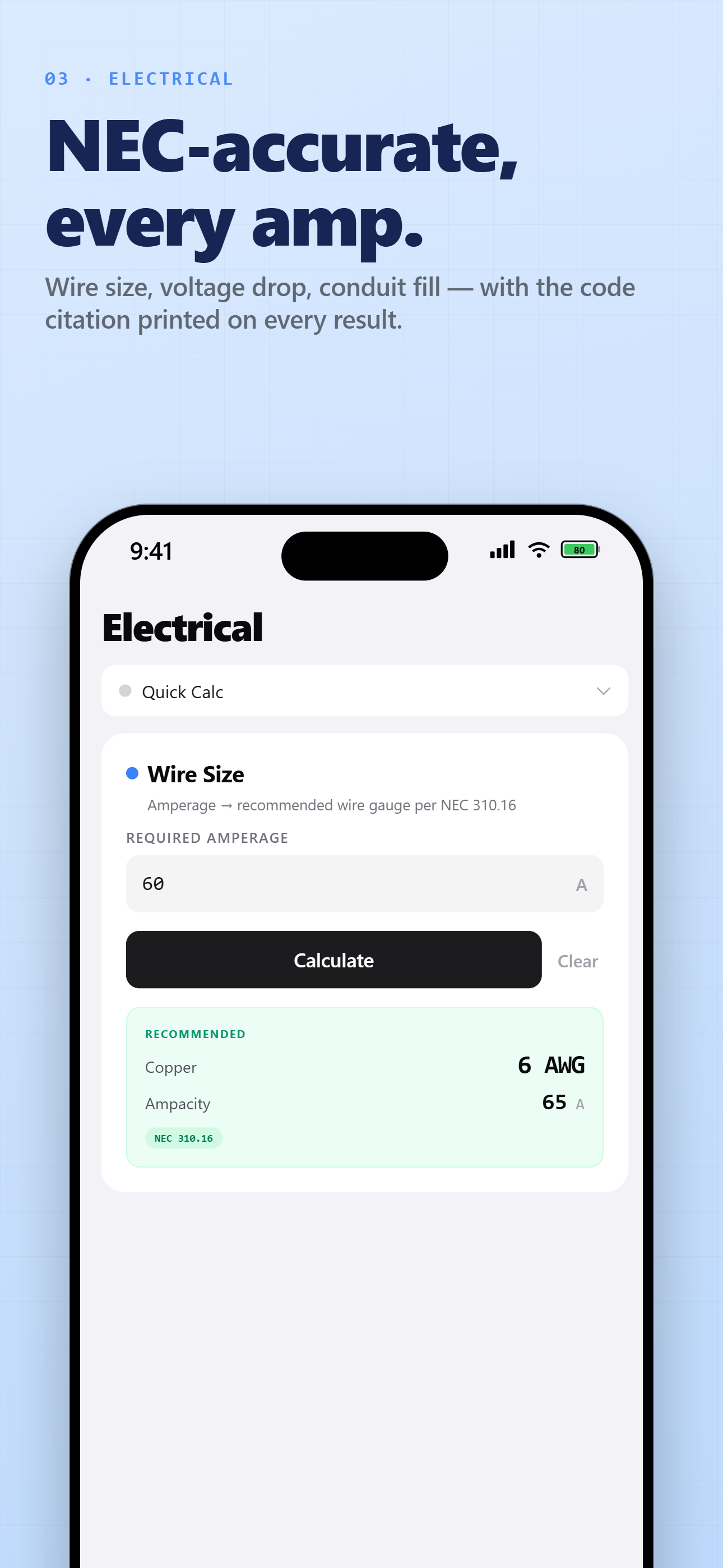
The Ground Wire Size calculator in FieldDojo asks which conductor you are sizing first. For an equipment grounding conductor, enter the breaker rating and pick copper or aluminum; it returns the Table 250.122 size and reminds you of the 250.122(B) upsize rule on the result. For a grounding electrode conductor, pick the largest service-entrance conductor; it returns the Table 250.66 size and prints the 250.66(A) ground-rod allowance next to it. The same tool runs in the browser at /calculators/ground-wire-size.
The 250.122(B) ratio is not automated in the app today; work it from the circular-mil areas in the wire sizing guide as shown in the first worked example above.
Get FieldDojo on the App Store → or on Google Play → — free on both.
All 57 calculators are free, work offline, and cite the code section on every result. FieldDojo Pro adds unlimited history, PDF reports, project folders and cloud sync.