Gas pipe sizing chart
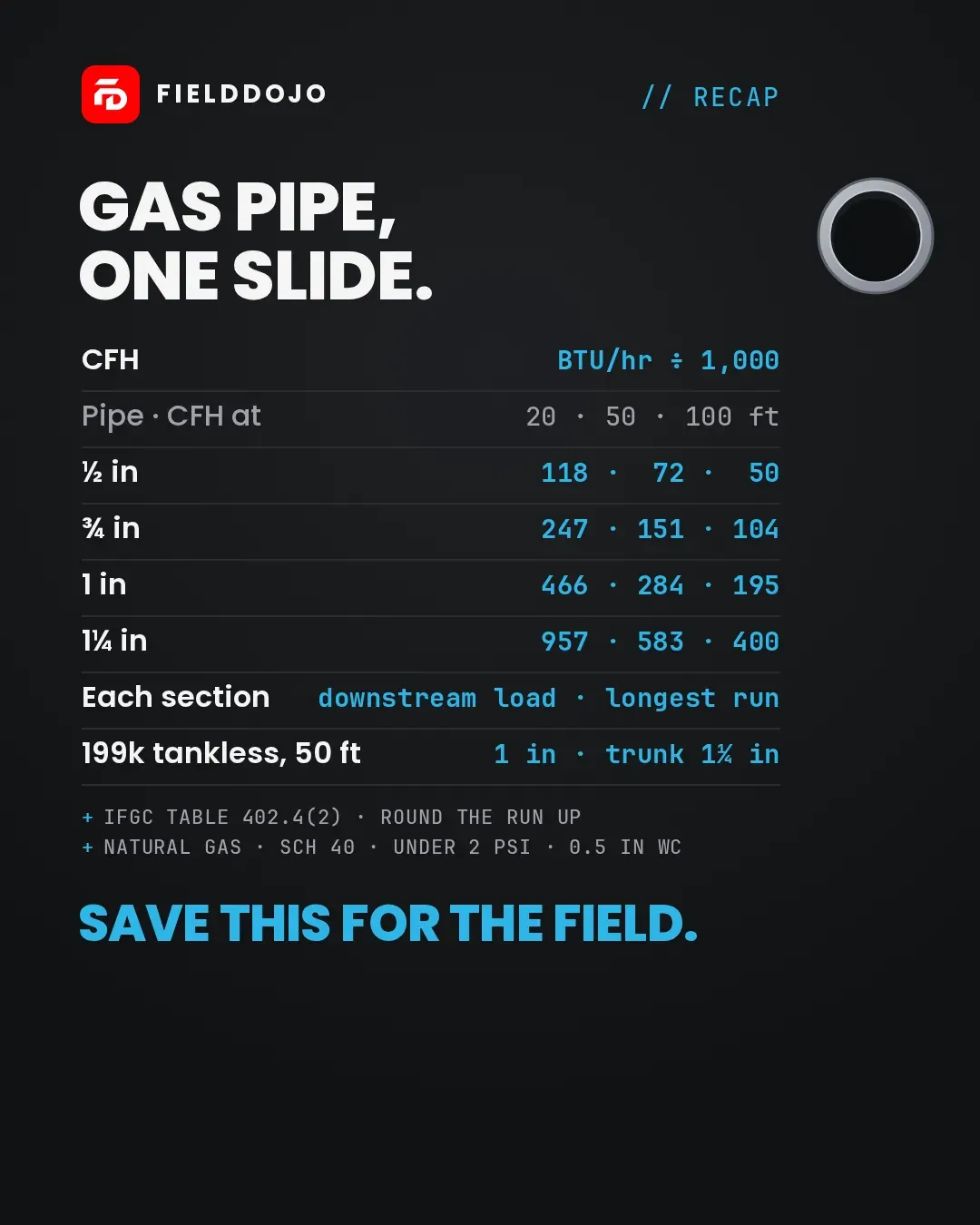
Schedule 40 black steel, natural gas, under 2 psi, 0.5 in WC drop: what ½, ¾, 1 and 1¼ in pipe carry at 20, 50 and 100 ft (IFGC Table 402.4(2)). Size each section by its downstream load and the longest run, and see what a 199,000 BTU tankless does to the trunk.
Natural gas · Schedule 40 black steel · under 2 psi · 0.5 in WC drop · specific gravity 0.60 · IFGC Table 402.4(2)
| Pipe | 20 ft | 50 ft | 100 ft | Code |
|---|---|---|---|---|
| ½ in | 118 | 72 | 50 | IFGC Table 402.4(2) |
| ¾ in | 247 | 151 | 104 | IFGC Table 402.4(2) |
| 1 in | 466 | 284 | 195 | IFGC Table 402.4(2) |
| 1¼ in | 957 | 583 | 400 | IFGC Table 402.4(2) |
| Step | Rule | Code |
|---|---|---|
| Load in CFH | BTU/hr ÷ 1,000 | natural gas at about 1,000 BTU per cubic foot |
| Each section | its downstream load · the longest run | IFGC 402.4.1 (longest length) |
| Between columns | round the run up | IFGC 402.4.1 |
| 199,000 BTU tankless, 50 ft | 1 in to the heater | 199 CFH > 151 (¾ in), ≤ 284 (1 in) |
| Trunk with the tankless | 1¼ in | 399 CFH > 284 (1 in), ≤ 583 (1¼ in) |
- Natural gas, Schedule 40 steel, under 2 psi at the meter, 0.5 in WC pressure drop. Propane, CSST and 2 psi systems have their own tables.
- CFH ≈ BTU/hr ÷ 1,000. The heating value of your local gas varies; the utility can tell you.
- The trunk example is a house with a 100,000 BTU furnace, a 65,000 BTU range and a 35,000 BTU dryer: 399,000 BTU with the tankless, all at 50 ft.
- After adding a big load, check the meter and regulator capacity with the utility.
Read the load in CFH, not BTU
The table is in cubic feet of gas per hour. Natural gas carries about 1,000 BTU per cubic foot, so divide the nameplate input by 1,000: a 100,000 BTU furnace is 100 CFH, a 40,000 BTU tank water heater is 40 CFH.
Size every section, by the longest run
Under the longest length method (IFGC 402.4.1), every section of pipe is sized from the same column: the length from the meter to the farthest outlet. (IFGC 402.4.2, the branch length method, lets a branch use its own run from the meter instead; the table here follows the longest length method, as the FieldDojo app does.) Then each section takes the load of everything downstream of it, and no more. The pipe at the meter carries the whole house; a branch to the dryer carries only the dryer.
Under that method, the common mistake is sizing a short branch from its own short length. A furnace on a 10 ft branch in a house whose longest run is 50 ft is sized from the 50 ft column, where ½ in carries 72 CFH, not from the 10 ft column. Between columns, round the run up: 45 ft reads the 50 ft column.
The tankless swap
A 40,000 BTU tank heater runs on ½ in pipe at 50 ft, with 72 CFH available. The 199,000 BTU tankless that replaces it needs 199 CFH, which is more than ¾ in carries at 50 ft (151) and fits 1 in (284). That is the branch.
The part even good plumbers forget is the trunk. Add the furnace (100,000), the range (65,000) and the dryer (35,000) and the section at the meter goes from 240 CFH, which 1 in carries, to 399 CFH, which needs 1¼ in. A tankless swap on the old gas line can fail inspection on the trunk alone, with a correctly sized branch.
What it does not cover
These capacities are for natural gas in Schedule 40 steel at under 2 psi with a 0.5 in WC drop. Propane, CSST, copper tubing and 2 psi systems use different tables. Longer runs and bigger pipe (1½ and 2 in, out to 300 ft) are in the FieldDojo app’s Gas Pipe Size calculator and in the pipe sizing guide.
Code references
IFGC Table 402.4(2)Schedule 40 metallic pipe, natural gas, under 2 psi, 0.5 in WC drop (the same values as NFPA 54's Schedule 40 natural-gas table)2015 editionIFGC 402.4.1Longest length method2015 edition
Section numbers and table values move between editions, and jurisdictions amend them. Confirm against the edition your authority having jurisdiction enforces.