· Updated · FieldDojo Team · construction · 9 min read
How to Calculate Concrete for Footings, Slabs, and Columns
Step-by-step concrete volume calculations for common pours — footings, slabs, walls, and columns. Includes waste factor guidance and ordering tips.
Ordering the wrong amount of concrete is one of the most expensive mistakes in construction. Too little means a second delivery charge and a cold joint. Too much means you’re paying for waste. Here’s how to get the numbers right.
Verify before you build. Section numbers, table values, and demand factors change between code editions, and jurisdictions adopt them with local amendments. Treat this guide — and the app — as a calculation aid, not as the code book: confirm every number against the edition your authority having jurisdiction enforces. How FieldDojo validates its calculations.
Concrete is Sold by the Cubic Yard
Everything starts with volume in cubic yards (CY). The formula:
Volume (CY) = (Length × Width × Thickness) ÷ 27The ÷ 27 converts cubic feet to cubic yards (1 CY = 27 CF). Ready-mix is ordered and priced by the cubic yard in the US.
Metric jobs are simpler — no divisor. Measure in meters and the product is already cubic meters:
Volume (m³) = Length × Width × ThicknessOne habit that pays for itself: measure the formed dimensions, not the plan dimensions. If the excavation ran wide or the subgrade dips, the real pour is bigger than the drawing says. Pull a tape on the forms, check thickness at several points, and run the numbers on what’s actually there — the waste factor covers variance, not measurement errors.
Slab Calculations
Example: 20’ × 30’ slab, 4” thick:
Volume = (20 × 30 × 0.333) ÷ 27 = 200 CF ÷ 27 = 7.41 CYAdd 5–10% waste factor for spillage, low spots, and subgrade variance:
Order: 7.41 × 1.08 = 8.0 CY → round up to 8.5 CYTypical slab thicknesses:
- 4” — residential driveway, patio, sidewalk
- 5” — light commercial, parking
- 6” — heavy vehicle traffic, industrial
Footing Calculations
Continuous footings (for foundation walls):
Volume (CY) = (Width × Depth × Length) ÷ 27Example: 16” wide × 10” deep continuous footing, 80 linear feet:
Volume = (1.333 × 0.833 × 80) ÷ 27 = 88.8 CF ÷ 27 = 3.29 CYSpread footings (for columns/posts):
Volume (CY) = (L × W × D) ÷ 27Example: 4 footings, each 24” × 24” × 12” deep:
Each footing: (2 × 2 × 1) ÷ 27 = 0.148 CY
4 footings: 0.148 × 4 = 0.59 CY → order 0.75 CY minimum
Note: small pours under about 1 CY are usually better served by bags rather than a ready-mix truck.
Column and Pier Calculations
Round piers (Sonotubes):
Volume (CY) = π × r² × Height ÷ 27Example: 12” diameter, 4 feet deep:
r = 0.5 ft
Volume = 3.14159 × 0.25 × 4 ÷ 27 = 3.14 CF ÷ 27 = 0.116 CY per pier
For 6 piers: 0.116 × 6 = 0.70 CY. Add 10% waste: order 0.77 CY.
Square columns:
Volume (CY) = Side² × Height ÷ 27Wall Calculations
Poured concrete walls:
Volume (CY) = (Length × Height × Thickness) ÷ 27Example: 40’ long × 8’ tall × 10” thick foundation wall:
Volume = (40 × 8 × 0.833) ÷ 27 = 266.7 CF ÷ 27 = 9.88 CYDon’t subtract for door openings unless they’re large — the rebar cage and pour complexity often means you’ll use the extra anyway.
Volume Formulas at a Glance
Every pour type above is the same move: multiply the dimensions, divide by 27. Here they are in one table.
| Pour Type | Volume Formula (CY) |
|---|---|
| Slab | (Length × Width × Thickness) ÷ 27 |
| Continuous footing | (Width × Depth × Linear Feet) ÷ 27 |
| Spread footing | (L × W × D) ÷ 27, × number of footings |
| Round pier | (π × r² × Height) ÷ 27 |
| Square column | (Side² × Height) ÷ 27 |
| Wall | (Length × Height × Thickness) ÷ 27 |
All dimensions in feet — convert inches first (divide by 12). For metric, use meters and drop the ÷ 27; the result is cubic meters.
Waste Factors by Pour Type
| Pour Type | Waste Factor |
|---|---|
| Slabs (flat, good subgrade) | 5–7% |
| Slabs (rough subgrade, grade changes) | 8–12% |
| Walls | 5–8% |
| Footings | 5–10% |
| Round piers | 10–15% |
When in doubt, add 10%. The cost of a half-yard overage is far less than a second truck.
Worked Example: Ordering Concrete for a Driveway
Put it all together on a real pour: a two-car driveway, 18’ wide × 40’ long, 4” thick, over compacted gravel that’s graded but not laser-flat.
Step 1 — Convert thickness to feet:
4" ÷ 12 = 0.333 ftStep 2 — Volume in cubic feet:
18 × 40 × 0.333 = 239.8 CFStep 3 — Convert to cubic yards:
239.8 ÷ 27 = 8.88 CYStep 4 — Apply the waste factor. A slab on rough subgrade takes 8–12% from the table above. Use 8%:
8.88 × 1.08 = 9.59 CYStep 5 — Round to an order quantity. Round up to the next half yard, the same way the slab example did:
Order: 10 CYStep 6 — Spec the mix when you call it in. Driveways often spec 4,000 PSI for durability. In a freeze-thaw climate, add air entrainment (5–7% air content) and request a 4–5” slump.
Sanity check the delivery method: at roughly 45 bags of 80 lb mix per cubic yard, 10 CY is about 450 bags. Nobody is mixing that in a wheelbarrow — this is a ready-mix truck, full stop.
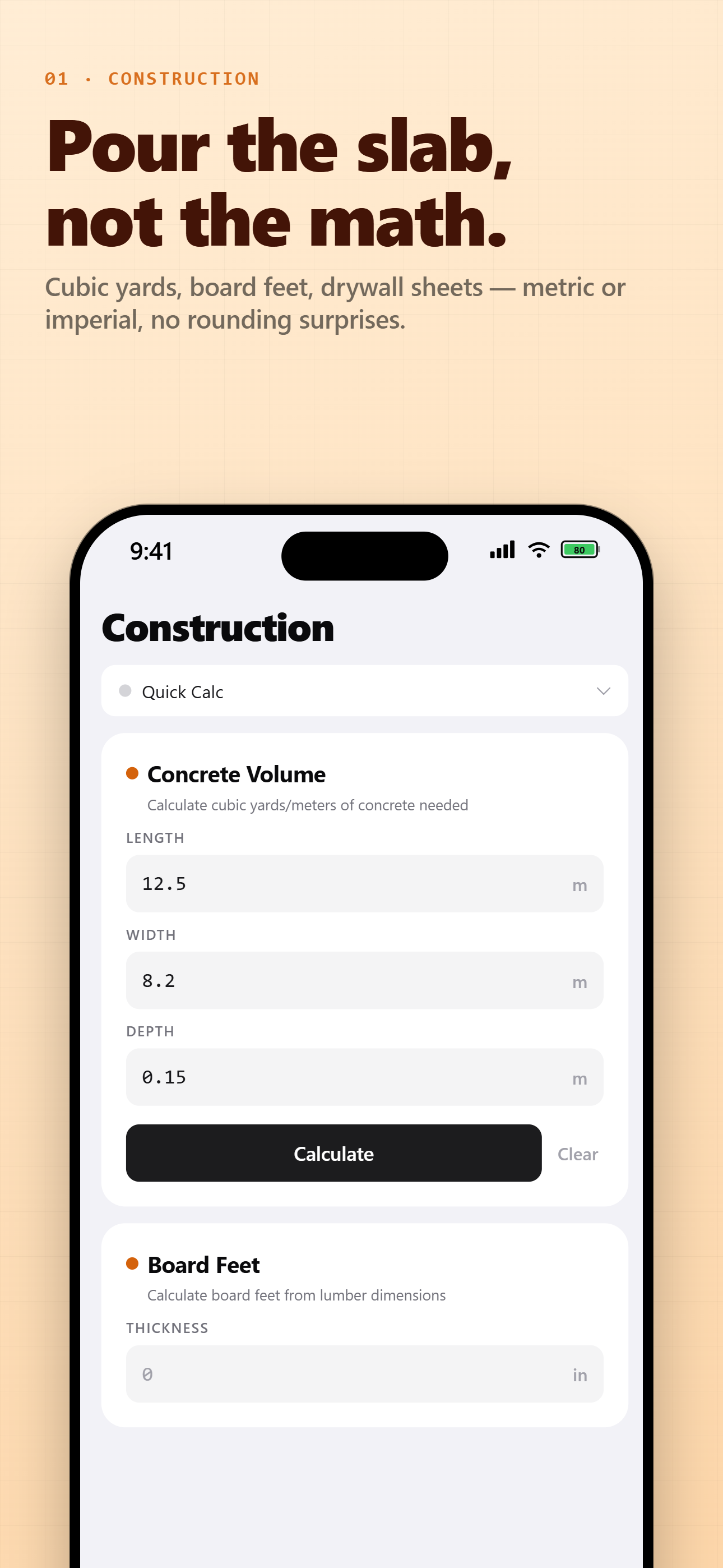
Metric version of the same job: a 12.5 × 8.2 m driveway at 0.15 m thick is 12.5 × 8.2 × 0.15 = 15.4 m³ before waste. Same waste factor and rounding logic apply.
Should You Order Ready-Mix or Mix Bags?
The crossover point is about one cubic yard.
Mix bags when:
- The pour is well under a yard — a few spread footings, a couple of pier holes, a small equipment pad
- The truck can’t reach the pour and a pump truck isn’t worth the cost for the quantity
- The work is staged over several days in small, independent placements
- The supplier’s minimum-order or short-load fee would cost more than the bags
Order ready-mix when:
- You’re anywhere near a yard or more — bag counts climb brutally fast
- The pour has to be monolithic. Mixing bags in batches on a slab or wall invites cold joints between batches
- The job specs a PSI mix or air entrainment — a batch plant hits the spec consistently; hand-mixed bags vary batch to batch
- Labor matters. Mixing, hauling, and dumping bags is slow, heavy work that ties up the crew
One more reason to be ready either way: plants charge standby time if the truck sits while you unload slowly, so a ready-mix pour needs the whole crew staged before the truck arrives.
If you’re on the fence, make two phone calls. Price the short load from the plant — including the minimum-order or short-load fee — then price the bag count: take your calculated volume, check the yield printed on the bag you’d actually buy, and divide. Compare total cost and the labor hours to mix that many bags. The truck wins that comparison earlier than most people expect.
Which PSI Mix Should You Order?
Volume tells you how much; the mix design tells the plant what to batch.
| Mix | Typical Use |
|---|---|
| 2,500 PSI | Sidewalks, patios, non-structural work |
| 3,000 PSI | Standard residential — footings, slabs |
| 3,500 PSI | Garage slabs, structural elements |
| 4,000 PSI | Foundations, commercial floors, driveways spec’d for durability |
| 4,500+ PSI | Special applications, precast |
Most residential work lands at 3,000–3,500 PSI. Structural concrete in the US falls under ACI 318 (Building Code Requirements for Structural Concrete) — if the plans call out a strength, order what’s on the plans, not what’s typical. Canadian jobs spec differently: CSA A23.1 works in MPa by exposure class rather than PSI grade (exterior flatwork exposed to freeze-thaw and de-icing salts, for example, is class C-2 at 32 MPa).
Ordering Tips
- Minimum order charges: Most ready-mix suppliers have a minimum (often 1 CY or a short-load fee). For small pours, pre-mix bags may be cheaper.
- Specify PSI: Use the mix table above as a starting point. Ask your engineer if in doubt.
- Air entrainment: Required in freeze-thaw climates — specify 5–7% air content.
- Slump: Request 4–5” slump for most pours. More than 6” means excess water and reduced strength.
- Timing: Have your crew and tools ready. Concrete waits for no one.
Frequently Asked Questions
How many bags of concrete do I need for a 10×10 slab?
A 10’ × 10’ slab at 4” thick is 10 × 10 × 0.333 = 33.3 CF, or 1.23 CY. At roughly 45 bags of 80 lb mix per cubic yard, that’s about 56 bags — call it 60 with a waste factor. At that count, price a ready-mix short load before committing to mixing by hand.
How much does a yard of concrete cover?
One cubic yard is 27 cubic feet. At 4” thick, that covers 81 square feet; at 6” thick, 54 square feet. The general rule: divide 27 by the thickness in feet. So for a 5” slab, 27 ÷ 0.417 ≈ 65 square feet per yard.
How do I calculate concrete in cubic yards?
Multiply length × width × thickness — all in feet — then divide by 27. Convert inches to feet first (4” = 0.333 ft). Add a 5–10% waste factor before ordering, more for round piers. On metric jobs, multiply the dimensions in meters and the result is already cubic meters.
How thick should a concrete driveway be?
4 inches is the standard for residential driveways, patios, and sidewalks. Go to 5 inches for light commercial or parking use, and 6 inches where heavy vehicles will run. Driveways often spec a 4,000 PSI mix for durability, with air entrainment in freeze-thaw climates.
What slump should I order for a slab?
Request a 4–5” slump for most pours — it places and finishes without giving up strength. Anything over 6” means excess water in the mix, and that water comes straight out of the concrete’s final strength. If the crew wants it wetter to move easier, fix the placement plan, not the mix.
How much extra concrete should I order?
Add 5–10% over the calculated volume for most pours — spillage, low spots, and subgrade variance eat it up. Round piers run higher, 10–15%, and rough subgrade pushes slabs toward 12%. When in doubt, add 10%: a half-yard overage costs far less than a second truck and a cold joint.
How FieldDojo Handles This
Every calculation in this guide is a few taps in FieldDojo’s concrete calculator:
- Slabs, footings (continuous and spread), columns, walls
- Applies your specified waste factor automatically
- Returns cubic yards, cubic feet, and number of 60 lb or 80 lb bags equivalent
- Works offline — no signal needed at the job site
Get FieldDojo on the App Store → or on Google Play → — free on both.
Related trade guides:
- Conduit Fill Calculations: NEC Chapter 9 Guide for Electricians — sizing the raceways that run under and through your slabs
- Pipe Sizing for Plumbers: Water Supply, Drainage, and Gas — the under-slab rough-in that goes in before the pour