· FieldDojo Team · electrical · 10 min read
NEC 220.83: Load Calculation for an Existing Dwelling (the 8 kVA Rule)
Can the existing service carry a new EV charger or heat pump? NEC 220.83 answers it: the first 8 kVA at 100%, the remainder at 40%, with worked examples.
A customer with a 100 A or 125 A service wants a Level 2 charger, a heat pump or an induction range, and the first question is whether the service they already have can carry it. NEC 220.83 is the section written for that question. It takes the existing loads plus the new one, counts the first 8 kVA at 100% and the remainder at 40%, and the result tells you whether the service stays or gets replaced. This guide covers both halves of the section, the measured-demand alternative in 220.87, and one house worked three ways.
Verify before you build. Section numbers, table values, and demand factors change between code editions, and jurisdictions adopt them with local amendments. Treat this guide — and the app — as a calculation aid, not as the code book: confirm every number against the edition your authority having jurisdiction enforces. How FieldDojo validates its calculations. The NEC is NFPA 70, published by the National Fire Protection Association.
Written against the 2023 edition of NFPA 70, the National Electrical Code. Section 220.83 carries the same number and the same percentages in the 2017 and 2020 editions.
What Does NEC 220.83 Cover?
Section 220.83 is an optional method for one situation: an existing dwelling unit, served by a 120/240 V or 208Y/120 V 3-wire service, where you need to know if the existing service or feeder has the capacity for additional load. It has two parts, and which one you use depends on what is being added.
| You are adding | Use | How the load is counted |
|---|---|---|
| Anything except air-conditioning or electric space heating | 220.83(A) | First 8 kVA of all load at 100%, remainder at 40% |
| Air-conditioning or electric space-heating equipment (alone or with other) | 220.83(B) | Heating or A/C at 100%, then the first 8 kVA of all other load at 100% and the remainder at 40% |
Source: NEC 220.83(A) and (B).
It is a different section from 220.82, the optional method for a new dwelling, which counts the first 10 kVA at 100%. The Article 220 guide walks through 220.82 and the Standard Method. The two numbers get mixed up on exams and on permit applications: 10 kVA belongs to 220.82, 8 kVA to 220.83.
What Goes Into the Load?
Both parts of 220.83 build the load from the same list:
- General lighting and general-use receptacles at 3 VA per square foot of floor area.
- 1,500 VA for each 2-wire, 20 A small-appliance branch circuit and each laundry branch circuit.
- Nameplate rating of:
- every appliance that is fastened in place, permanently connected, or on a specific circuit
- ranges, wall-mounted ovens and counter-mounted cooking units
- clothes dryers that are not on the laundry circuit above
- water heaters
The new load goes on the same list at its nameplate. For an EV charger, NEC 220.57 sets the figure at 7,200 VA or the nameplate, whichever is larger, and NEC 625.42 lets you use the lower setpoint of an energy management system when one limits the charger.
Under 220.83(A), existing air-conditioning or electric heat is on the list too. The common reading, and the one exam-prep courses teach, is that it rides through the 8 kVA and 40% steps with everything else, because nothing in (A) pulls it out at 100%. Ask your inspector if the answer turns on it.
220.83(A): Adding a Load That Is Not Heating or Cooling
Calculated load = 8,000 VA + 0.40 × (total VA − 8,000 VA)
Service amps    = calculated load ÷ 240 V
Example house, 2,000 sq ft, existing loads:
- General lighting: 2,000 × 3 = 6,000 VA
- Small-appliance circuits: 2 × 1,500 = 3,000 VA
- Laundry circuit: 1,500 VA
- Electric range: 8,000 VA
- Dryer: 5,000 VA
- Dishwasher: 1,200 VA
- Water heater: 4,500 VA
- Central A/C with air handler: 8,400 VA
- Existing total: 37,600 VA
The owner wants a 48 A Level 2 charger. Nameplate is 48 A × 240 V = 11,520 VA, which is larger than the 7,200 VA floor in 220.57.
- New total: 37,600 + 11,520 = 49,120 VA
- First 8,000 VA × 100% = 8,000 VA
- Remaining 41,120 VA × 40% = 16,448 VA
- Calculated load = 24,448 VA
I = 24,448 ÷ 240 = 101.9 AOn a 125 A service the charger fits. On a 100 A service it is 1.9 A over, and the service fails the calculation.
The Same Charger Behind an Energy Management System
Limit the charger to 30 A with a listed energy management system and the load you enter is 30 A × 240 V = 7,200 VA:
- New total: 37,600 + 7,200 = 44,800 VA
- First 8,000 VA × 100% = 8,000 VA
- Remaining 36,800 VA × 40% = 14,720 VA
- Calculated load = 22,720 VA
I = 22,720 ÷ 240 = 94.7 A94.7 A is under 100 A. The same house keeps its 100 A service, and the cost is charging speed: 30 A at the car, down from 48 A. The branch circuit is still sized at 125% of the continuous current the charger is set to. The breaker sizing guide covers that step.
220.83(B): Adding Heating or Air-Conditioning
When the new equipment is air-conditioning or electric space heating, it comes out of the demand factor and counts in full.
| Load | Percent of load |
|---|---|
| Air-conditioning equipment | 100% |
| Central electric space heating | 100% |
| Fewer than four separately controlled space-heating units | 100% |
| First 8 kVA of all other loads | 100% |
| Remainder of all other loads | 40% |
Source: NEC 220.83(B). Use the larger connected load of air-conditioning or space heating, not both.
Example: the same house swaps its gas furnace for 10 kW of electric heat. The heat (10,000 VA) is larger than the A/C (8,400 VA), so the heat is the one that counts.
- Heating at 100%: 10,000 VA
- All other loads (the list above without the A/C): 29,200 VA
- First 8,000 VA × 100% = 8,000 VA
- Remaining 21,200 VA × 40% = 8,480 VA
- Calculated load = 10,000 + 8,000 + 8,480 = 26,480 VA
I = 26,480 ÷ 240 = 110.3 AThat fits a 125 A service and fails a 100 A one. Compare it with the EV case: 11,520 VA of charger added about 19 A to the calculation, because 40% of it counted. 10,000 VA of heat displaced an 8,400 VA A/C and still pushed the result past the charger’s, because every volt-ampere of it counted.
220.87: Use the Meter Instead of the Arithmetic
NEC 220.87 lets you set the calculation aside and use what the house has actually drawn. Three conditions, all required:
- Maximum demand data for one year. If a year is not available, the exception accepts a continuous recording of at least 30 days: the highest average kilowatts held for a 15-minute interval, measured on the highest-loaded phase while the building is occupied, and including the larger of heating or cooling by measurement or calculation.
- 125% of that maximum demand plus the new load does not exceed the rating of the service or the ampacity of the feeder.
- The feeder has overcurrent protection under 240.4, and the service has overload protection under 230.90.
Example: the utility’s interval data shows a 12.4 kW peak over the last twelve months.
- 12.4 kW × 125% = 15.5 kVA
- Add the 48 A charger: 15.5 + 11.52 = 27.02 kVA
I = 27,020 ÷ 240 = 112.6 AFor this house, 220.87 gives a higher number than 220.83(A) did (112.6 A against 101.9 A). In a house with gas appliances and a small recorded peak it often goes the other way. You are allowed to use whichever method the service passes, so run both before you price a service upgrade.
Which Method Should You Use?
| Situation | Method |
|---|---|
| New dwelling, sizing the service from scratch | 220.82 or the Standard Method |
| Existing dwelling, adding a charger, range, hot tub or water heater | 220.83(A) |
| Existing dwelling, adding or enlarging A/C or electric heat | 220.83(B) |
| Existing dwelling with a year of utility demand data | 220.87, checked against 220.83 |
| Multifamily feeder or a service that is not 3-wire 120/240 V or 208Y/120 V | Standard Method (220.83 does not apply) |
Frequently Asked Questions
Under the optional method for an existing dwelling, what demand factor applies to loads beyond the first 8 kVA?
40%. NEC 220.83(A) counts the first 8 kVA of load at 100% and the remainder at 40%. Under 220.83(B), the same 8 kVA and 40% split applies to all loads other than the air-conditioning or space heating, which count at 100%.
What is the difference between NEC 220.82 and 220.83?
220.82 is the optional method for sizing the service of a dwelling unit: the first 10 kVA of general load at 100%, the remainder at 40%, and the larger of heating or cooling added on top. 220.83 is for an existing dwelling where you are checking whether the service already there can take more load: the first 8 kVA at 100% and the remainder at 40%.
Can I add a 48 A EV charger to a 100 A service?
It depends on what else is in the house, and the calculation decides. In the all-electric example above, a 48 A charger brings the 220.83(A) load to 101.9 A, which fails on a 100 A service; the same charger limited to 30 A by an energy management system brings it to 94.7 A, which passes. A house with gas heat, a gas range and a gas water heater has far less on the list and usually passes without the limit.
Does existing air-conditioning count at 100% under 220.83?
Under 220.83(B), yes: when you are adding air-conditioning or electric space heating, the larger of the two counts at 100%. Under 220.83(A), where no heating or cooling is being added, the section gives only two percentages (8 kVA at 100%, the remainder at 40%) for existing and new loads together, so existing A/C is normally included with the rest. Confirm that reading with your authority having jurisdiction.
Can I use 220.83 for an apartment building?
Not for the building’s service. The section covers a dwelling unit served by a 120/240 V or 208Y/120 V 3-wire service or feeder, so it can check the feeder to one unit. A multifamily service is calculated under 220.84 or the Standard Method.
Is a 30-day load recording enough for NEC 220.87?
Yes, under the exception, when a year of demand data is not available. The recording has to be continuous for at least 30 days, taken on the highest-loaded phase while the building is occupied, and it has to account for the larger of the heating or cooling load and for other seasonal loads, by measurement or by calculation.
How FieldDojo Handles This
FieldDojo’s Dwelling Load calculator runs the Standard Method of Article 220, and the same tool is in the browser at /calculators/nec-load-calculation. It does not run 220.83. What it gives you for an existing-dwelling check is the tabulation: enter the floor area and the appliances and it lists each load in VA with the section it came from, which is the list 220.83 starts from. The 8 kVA step is then two lines of arithmetic:
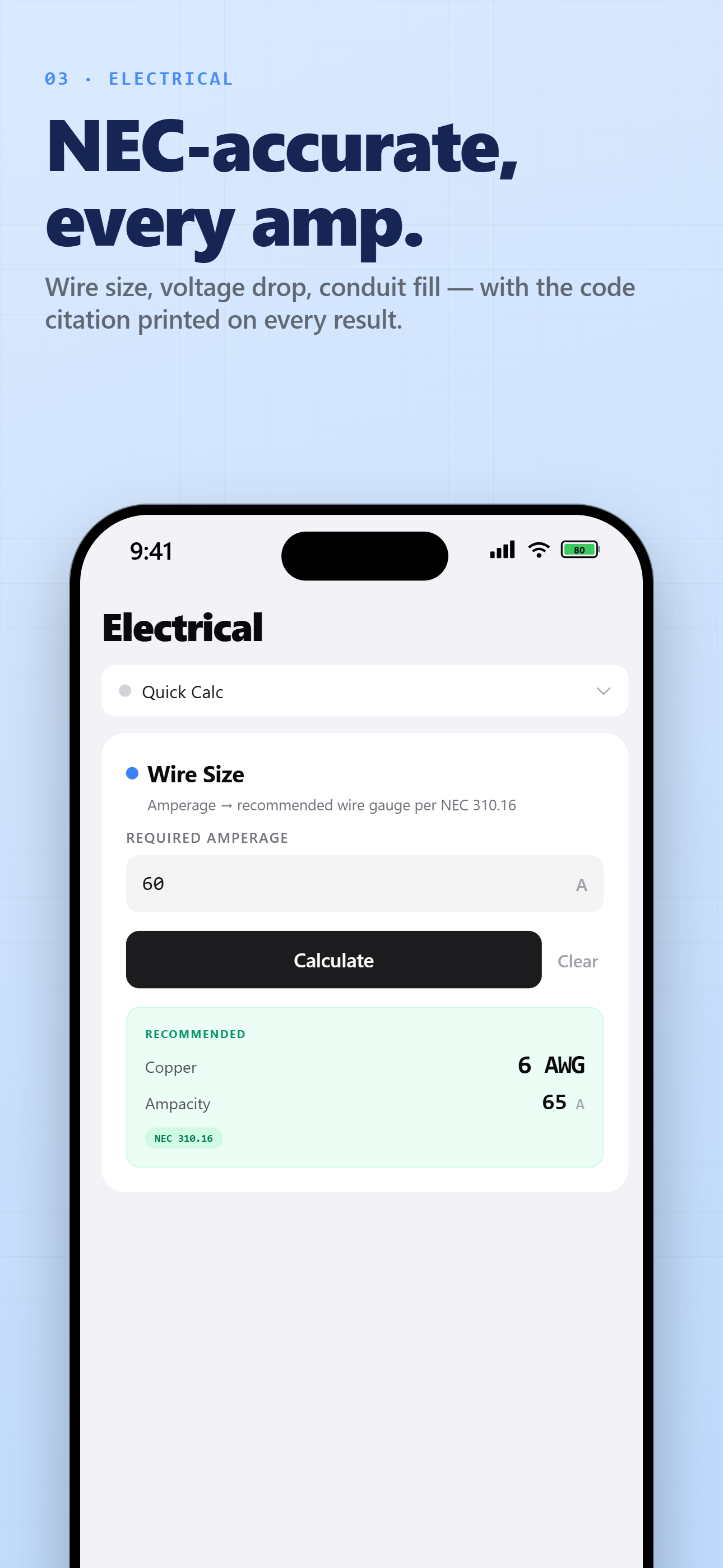
Calculated load = 8,000 + 0.40 × (total VA − 8,000)Save the result to the customer’s project and the numbers are there when the inspector asks how the service was checked. For the circuit itself, Breaker Size applies the 125% continuous-load rule and Wire Size applies Table 310.16.
Get FieldDojo on the App Store → or on Google Play → — free on both.
Related trade guides:
- Residential Electrical Load Calculation: NEC Article 220 — the 220.82 optional method and the Standard Method for a new service
- Breaker Sizing: NEC 240.6 Standard Ratings and the Next-Size-Up Rule — the 60 A breaker behind a 48 A charger
- Wire Sizing and Voltage Drop: NEC Guide for Electricians — conductors for the new circuit
All 65 calculators are free, work offline, and cite the code section on every result. FieldDojo Pro adds unlimited history, unlimited projects, cloud sync and the Pro report style and editor.